 Supporting Serendipitous Asset Exploration for Collage-Based Storytelling
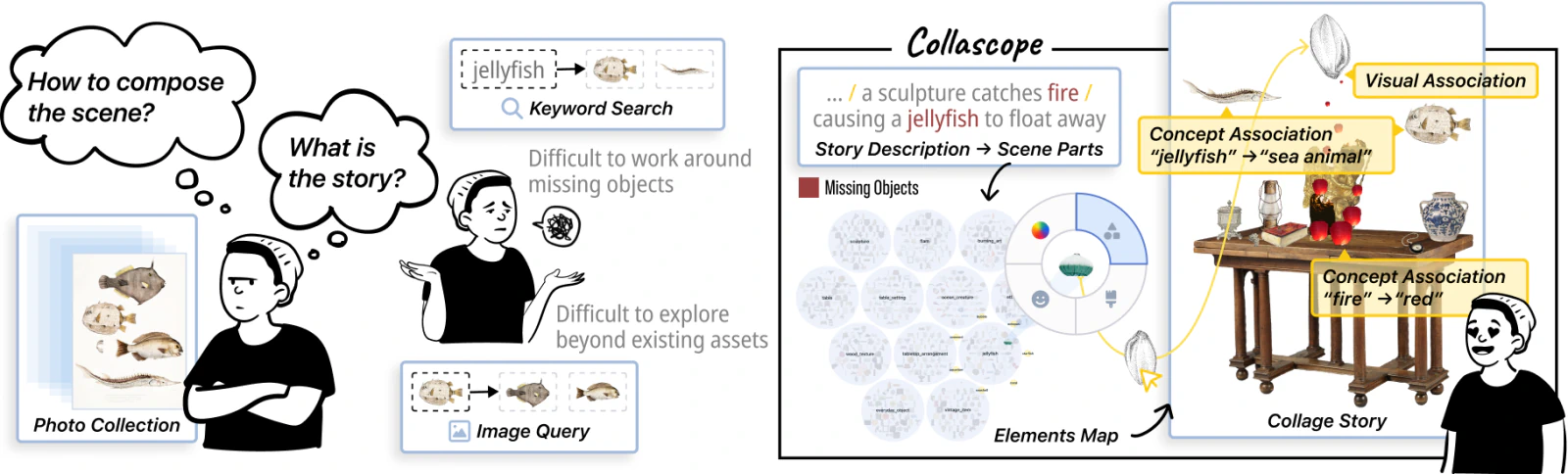
Story collaging involves continual negotiation among evolving narrative intent, available assets, and visual composition. Unlike conventional search workflows, which require creators to fragment stories into disconnected queries, Collascope structures evolving intent through Scene Parts and expands exploration through Concept Association and Cutout Association. Unexpected and imperfect results can then serve as materials for revising the story and enriching the collage.
Method
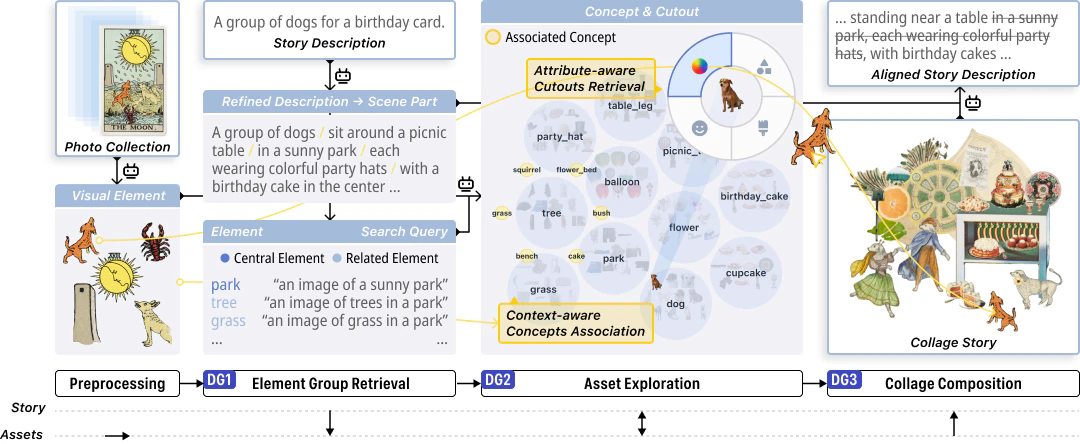
Collascope turns an evolving story description into structured Scene Parts and visual elements, then supports context-aware Concept Association and attribute-aware Cutout Association. Selected assets flow directly into collage composition, while the aligned story description evolves with the scene.
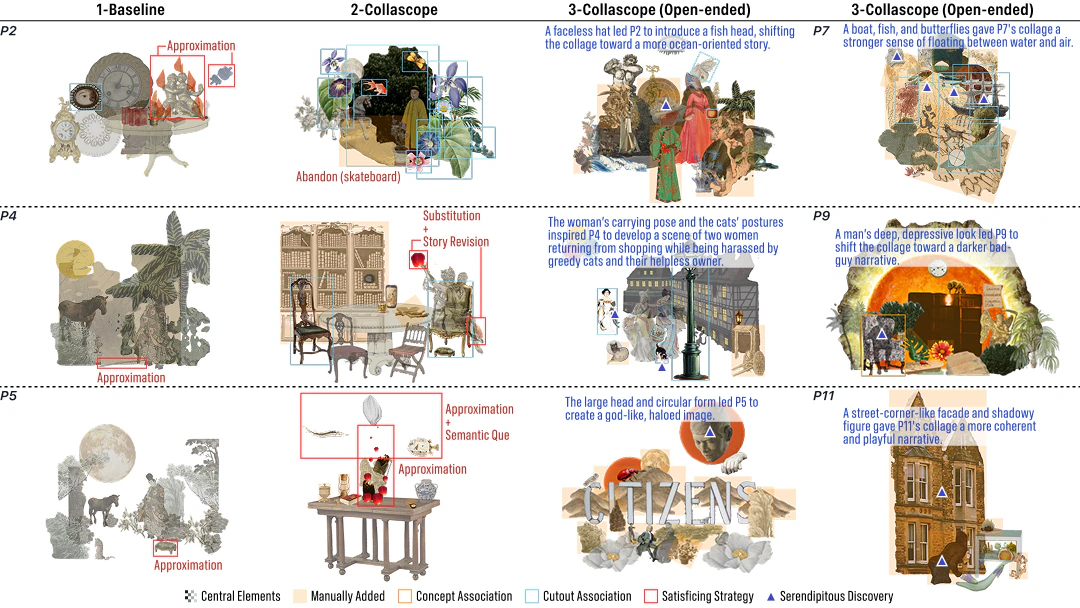
Collage stories created with Collascope in our user study.
Showing 6 selected collages.
User Study Findings
We evaluated Collascope in a within-subject study against a conventional search baseline. Beyond stronger perceived support for exploration and expression, Scene Parts helped participants externalize emerging story structures and keep track of what they had already explored.
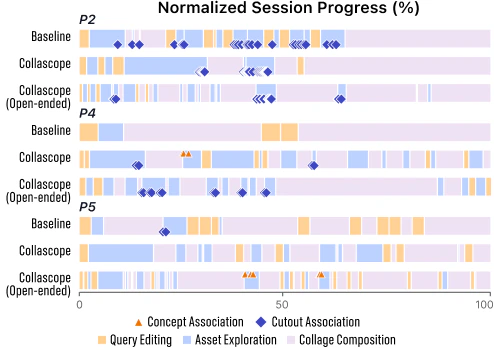
Three recurrent ways of using Association
Participants incorporated Association differently depending on whether exploration was guided by a clear goal, an evolving story, or visual intuition.
- Goal-oriented P5 P6 P9
- Used Association selectively while following a clear target.
- Story-driven P3 P4 P8 P10 P11 P12
- Alternated manual concepts and Association as the narrative changed.
- Visual-driven P1 P2 P7
- Repeatedly followed related cutouts beyond the initial search target.